THE HSC: A BIASED SYSTEM

The educational standards in Australia have slowly eroded over time. Our education custodians have failed to reform a heavily biased assessment system that favours students with only a specific subset of skills.

How is the HSC setup?

The Higher School Certificate (HSC) employed by the NSW Department of Education is designed on the basis of ‘merit’. However, unlike the grading systems at the majority of tertiary institutions, the merit that the HSC rewards is collective, rather than individual.

Using what is known as a ‘ranking’ methodology, the current HSC is split into internal and external examinations. Students’ complete examinations set by their own teachers that are aggregately worth 50% of their total marks. Likewise, at the end of the Year 12 academic year, the students sit ‘high-stakes’ exams set by an independent party (same exam for everyone) that are symmetrically worth 50% of their grade.

Seems pretty simple, right? Students do exams at their school and complete external exams at the end of the year.

What do the ‘rankings’ mean for the HSC results?

Where do rankings come into this? In a perfect world, students would sit their internal and external exams and obtain a grade based on their marks in both schedules of assignments. With the addition of a ‘scaling’ system for the pre-determined ‘harder’ subjects such as Extension Mathematics, Physics, Chemistry, Languages and Extended English.

The drawback with a pure ‘grading’ system (like the ones used in universities) is that it does not provide a ‘safety net’ for students that fail to excel in some of the exams. Marks are fair and sometimes unforgiving but provide an unbiased picture of a student’s performance in a subject.

Therefore, the custodians of the current HSC system prefer the implementation of ‘collective competition’. This system encompasses providing ranks to students in their immediate cohort (school class) instead of grades. Thus, their grades for internal examinations/assignments are somewhat irrelevant, it is only their rank relative to their peers that is important. This eliminates the possibility of teachers inflating their students marks for internal exams.

However, whilst this is a brilliant system for internal examinations, the remaining element of the mechanism fails to capture the principle of fairness. Students obtain a ‘grade’ for their final external exam at the end of the HSC. Instead of getting their own mark for the exam, they are assigned the grade from their classmate’s exam that aligns with their internal rank. For example, if John ranked 3rd in his class for English for his internal exams but ranked 10th in the final exam. He would be given the mark of the student that achieved the rank of 3rd in the final exam. Hence, John has a safety net going into the exam, knowing he will assume the grade of the member of the class that ranks 3rd.

What happens to the internal grades? The inverse occurs. John’s internal mark (he ranked 3rd in internal exams) will be assigned to the classmate that ranked 3rd in the final HSC exam. Whilst John takes the grade of the student that ranked 10th in his class (he came 10th in the final exam). In other words, the mark a student will take for the internal exams is equivalent to their own rank in the final HSC exam.

The grades are also weighted through a ‘scaling’ system, wherein the difficulty of the subject is considered. Then, a final ‘rank is distributed to students based on the aggregate of their allocated marks (i.e add up their allocated marks from the internal and external assessments). This aggregate mark is ranked against every student in the HSC across all subjects. This final rank is known as an ATAR (Australian Tertiary Admissions Rank). This rank is standardised across all the states in Australia.

Why this system of grading?

Lost yet? Confusing, I know.

This system is employed for a few reasons:

  • Prevent schools from over-inflating their internal marks for students.
  • Foster competition between students in order to improve their performance and productivity throughout the academic year.
  • Ensure ‘cohorts’ with a larger number of ‘excellent’ students to have larger opportunity to do well.
  • Ensure the ‘final HSC exam’ is the most important examination, with an independent regulator that ensures fairness for students.

Who is disadvantaged?

The benefits seem pretty convincing. A focus on fairness and providing rewards to ‘collective cohorts’ that have a larger number of well-performing students. However, there are significant drawbacks that fosters students with large amounts of potential to be wasted:

  • Students in ‘poor performing’ classes are disproportionately downgraded in marks due to the lower grades of their peers.
  • The ATAR rank is an aggregate of all subjects, and thus doesn’t give students merit to focus on their passions and favourite subjects. Hence, this disavows specialisation and encourages students to be ‘jacks of all trades’, rather than experts in their own field.
  • Provides ‘private schools’ that have significant funding, the ability to ‘cushion’ their under-performing students with ‘high-performing’ students in order to achieve a better overall rank.
  • ‘High achievers’ in ‘poor performing’ cohorts are pressured into anti-social behaviour such selective assistance to students, misleading information to peers (competitors) and disruptive tendencies in their class in order to consolidate their higher rank.
  • Students have limited sense of ‘ownership’ of their marks, rather an ownership of their ‘rank’. Thus, embedding counter-productive ideas that society is focused on ‘a system of ranks’ rather than individual merit. This is leads to a large number of development problems in student after the HSC.
  • Students that select ‘harder’ subjects are destined to be scaled higher. Thus, students that choose ‘creative’ subjects such as drama, arts and social sciences to be left behind.

What is the solution?

The current system is clearly biased towards privatised schools and cohorts with a large number of ‘high achieving’ students. These cohorts consist of ‘all-rounders’ that do not specialise in fields of interest. This needs to be transformed into a mesosystem of independent ‘specialised’ areas of study that are autonomous in their grading.

In other words, ditch the overall rank at the end; and implement separate grades for each vocation or subject. Let the students excel at the things they want to excel in.

How do we achieve this?

Here is a sample blueprint:

  • Replace the ATAR rank with a grading system that is based on marks achieved by each student. This would remove the purchasing power of privatised schools that garner a comparative advantage through the ‘cohort ranking’ system.
  • Remove the ‘aggregate’ approach to the final grade. Each subject/field should provide their own grades to the students based on the most appropriate form of assignments such as work experience, practical placements, traditional examinations, or oral assessments.
  • Universities adjust their admissions system to prominently consider the grades for each student by the relevant subject(s) for each course, rather than the overall HSC grade. This would represent a shift towards ‘specialisation’ instead of the ‘generalisation’ of the skill profile of students.
  • ‘Decentralisation’ of examination content to provide students with a greater choice for material that they wish to be examined upon. This would involve the phasing out of standardised testing for the final HSC exam. The exams/assessments should be specific to the demographics of the region that is being examined. Rather than utilising an arbitrary examination structure that only benefits a select few schools that have stakeholders in the Board of Studies.
  • Broader the definition of ‘intelligence’ to encompass creativity, arts, volunteering, social work and ‘trades’. This includes the numeration (through grades) of non-normative skills such as imagination, workmanship, and technological innovation.  These skills gave incredible social value but are disproportionately under-valued in the tertiary education market. This should lead to the creation of a new university market for non-traditional courses that can up-skill students for long-term placement in fulfilling career paths.

The HSC is not broken. It needs an overhaul to get the best out of a changing demographic of students that want to be counted and contribute to society. We need to give them the chance to just that.

Daniel Dell’Armi

The ‘Super’ Elite: The Monopoly of Power in Football

What is the ‘football pyramid’?

The ‘football pyramid’ is a metaphorical visualisation of the structure of European football. Similar to the ‘trickle down’ model of economics, the pyramid is heavily reliant on the success of ‘elite’ or ‘top tier’ clubs that drive revenues for the rest of the football community.

The national federations for football in consultation with the ‘top-flight’ clubs in each national league determine the distribution of funds to the clubs in the lower leagues. The intended idea for this structure to utilise the significant revenues of the commercialised clubs and leagues and re-distribute the resources to the lower divisions. Therefore, the financial responsibility lies with the premier clubs of each domestic league.

An example of such programs to re-invest football profits into the pyramid are ‘Solidarity Payments’. These are made to the clubs in the lower leagues such as the EFL Championship, League One and the National League in order to invest in infrastructure, stadiums upgrades and maintenance, training facilities, and general business functions for the smaller clubs. These payments are applied to the transfer of a player from one club to another as a percentage of the total fee.

However, the majority of grants that flow from the top of the pyramid to the grassroots level are in the form of capital investments are made by the league associations in coordination with the member clubs of that specific division. Thereby, the political games become an inherent foundation of the ‘funding’ process as clubs and governing bodies decide the optimal amount of assistance to provide the smaller clubs.

Who is on top of the pyramid?

The ‘Big Six’ clubs of England dominate the market share, alongside the heavyweights of Bayern Munich, Real Madrid and FC Barcelona. These clubs entice huge sums of broadcasting fees for media conglomerates of the domestic leagues such as the English Premier League and La Liga. The matchday revenues have significantly increased with larger stadium capacities from recent upgrades to hubs like Anfield and the newly built Tottenham Hotspur Stadium. In fact, the revenue in the footballing network in England alone has almost doubled over the last ten years according to some pundits and insiders in the community.

These patriarchal clubs are not alone at the top of the mountain. The governing bodies that provide oversight for transfer market, league rules, qualification prerequisites and football development possess an enormous amount of power. FIFA, UEFA, the FA and the complementary governing bodies from other nations represent the collective interests of fair and meritorious competition.

The governing bodies operate, organise, and run the domestic leagues, knock-out tournaments and European Cups that configure a pyramid of competitive annual seasons. The top teams from each league are promoted to the next division until the point they reach the UEFA Champions League, which represents the pinnacle of football competition in Europe. The existence of a promotion and relegation mechanism ensures the stakes of each season are consistent with the ethos of football as a meritocracy.

However, there is an epidemic of commercialisation within the World Game. The ‘Big Six’ of England have been transformed from a ‘working class’ identity to the corporate business model through financial takeovers and mergers with overseas venture capitalists such as the Fenway Sports Group (FSG), Kroenke Sports & Entertainment, and the Glazer Family ownership of Manchester United. As a result, the livelihood of semi-professional teams, small clubs in the national divisions and grassroots football are dependent on the altruistic authenticity of these stakeholders. By extension, the prosperity of the football community is contingent on the sanctity of the pockets of such wealthy businesspeople.

Hence, it can be viewed the current setup is an oligopoly with privatised elements from overseas sources that represent the power base for the business of football in Europe.

Why is the ‘Super League’ such a fuss?

The proposed ‘European Super League’ is a supposed replacement for the current UEFA Champions League that is run by the independent governing body of the same name. The premier clubs of Europe are dissatisfied with the proportional split of broadcasting, commercial and matchday revenue that is provided by UEFA for the completion of each European football fixture. In their eyes, the domestic leagues should not be the epicentral source of revenue for clubs.

In other words, the lack of consistent marquee matches, ‘cap’ on the revenue streams, and inability to ensure annual qualification into the Champions League create an unsustainable revenue model for the biggest clubs in Europe.

Hence, the idea of the European Super League (ESL). This would allow the biggest clubs in Europe to guarantee their place in the foremost league in Europe. As a result, the Founding Clubs of this league would have full control of the broadcasting split, number of matchdays throughout the season and the intellectual property of the principal prize in European Football. Most importantly, the exclusive ability to monetise their club’s consistent participation in this ‘Mount Olympus’ of football.

However, the owners of such clubs have myopic vision. Underpinning the current ‘football pyramid’ is an ethos of fairness, merit, and open competition. Whilst the language of revenues is unbiased in the sense of power. It is unbelievably biased against the success of smaller clubs in a market filled with cash-driven giants. The unexpected backlash towards the ESL from the fans, national governments and former players was irreconcilable. The ESL in its original proposed form would not be allowed to prosper in an ecosystem of tribalism at its core.

Where does the ‘beautiful game’ go from here?

The ESL proposal is a microcosm for a larger divide within the game. The ideological battle between fans; and the owners, and directors of the Europe’s biggest clubs and governing bodies. Whilst governing bodies such as UEFA may construe that they represent the ideals of fairness and merit. Their sole purpose is to maximise revenues for their competitions in the domain of a highly mercantile footballing landscape.

Likewise, the ‘Big Six’ and the premier clubs of Europe have transformed from entities of the ‘people’ to businesses that operate on balance sheets. The Machiavellian ambition to maximise profits, rather than enjoyment (or entertainment) for fans is a crucial distinction in the contemporary era of football. The unparalleled push for the ESL supports this argument in a nutshell.

This division between the fans and the controlling powers in Europe cannot be sustained for much longer. The increasing debts, costs, and liabilities in the era of Covid are making clubs unsustainable investments for owners. The bloated transfer market, unsustainable wage bills and inability to account for uncertainty are the root causes for the large losses at the biggest clubs in Europe. Something must be done to curb such poor business management.

Sports as a business is volatile. Owners and shareholders must be risk-averse in the operations of football clubs. Therefore, instead of proposing projects that enrich the divide between the fans and owners. The clubs must look toward cost-control measures that aim to stabilise and reduce spending in order to account for variable change in the market. For instance, the implementation of salary caps for clubs, introduction of trading schemes to transform the transfer market into a sustainable marketplace for transactions and transition to fan-owned (50 plus one) financial models for larger clubs.

Otherwise, the commercialisation of football will reach a turning point wherein the fans are only customers. The once mystical nature of football would be dead, and the green machine will be out of gas.

Daniel Dell’Armi.

The Philosophy of Privatisaton: USA Healthcare

Overview

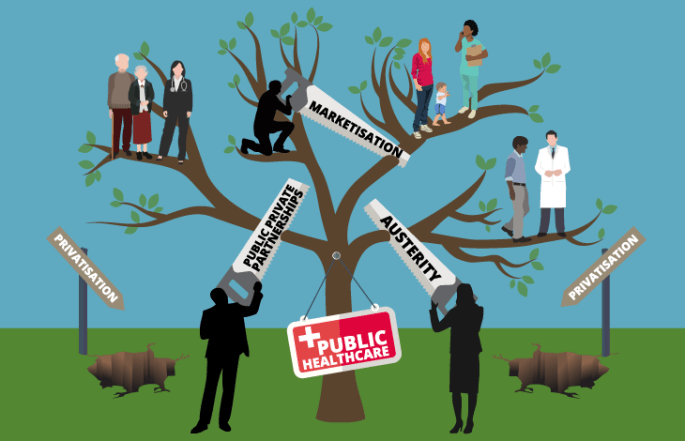
Healthcare in the United States is classified as a consumer product and not a universal constitutional or legal right. The system is a hybrid model that incorporates an uneven balance between the elements of privatised and public networks. The burden of responsibility for government supervision the is divided into primarily the federal and state level with minimal involvement from local authorities. However, the main point of separation exists in the marketplace for insurance. The private sector utilises an ‘employer-facing’ scheme that provides a substantial amount of purchasing power to privatised entities such as pharmaceutical companies, private hospital providers, commercialised ‘extras’ options and managed care organisation. Whereas the government sphere funds various welfare schemes for disadvantaged consumers with pre-existing conditions and primitive access to jobs, and proportionally distributes federal and state taxpayer money into public infrastructure. Both realms of the system significantly limit the options, opportunities, affordability and coverage for consumers. The introduction of the colloquially coined term, ObamaCare, in 2014 introduced measures to alleviate these limitations. However, further micro-economic reforms are required to increase the competitiveness of the public sector, increase the power of middle-class consumers in the private insurance market and curb the influence of private firms in the industry.

Structure

The healthcare infrastructure is an amalgamation of taxpayer bureaucratic funding and privatised investment.  The private infrastructure is funded through venture capitalists, charitable donations, shareholders and private insurance. Hospitals, mental institutions, dentists and other ‘extras’ options are all included in this sphere. The access to these services is limited to paying customers, either through an insurance plan or direct cash basis. The shortfall between the amount covered by insurance and the total price levied by the private entity is called the ‘out-of-pocket’ sum for consumers. Traditionally, those in the upper middle-class or elitist societal classes can afford this form of healthcare through their employers or direct purchase in some cases. The inelastic nature of medicine allows providers to charge relatively high prices without the fear of deadweight loss. This profitability is a key contributor to the expansion of the private market into a commercialised force that induces incredibly elevated prices that often do not match the true market-clearling equilibrium. Therefore, the producer surplus significantly exceeds the consumer surplus in the healthcare market. This represents a fundamental problem for an industry that is designed to altruistically create positive externalities for consumers rather than producers. Hence, it is lucid that the capitalistic framework of the private sector has lead to the unfair distribution of healthcare in the country.

Inefficiencies of the Public System

Moreover, the public infrastructure acts as a ‘safety net’ for those that cannot afford access into privatised services. Public entities cannot refuse entry to uninsured or impoverished members of society. Thenceforth, the lack of privatised pricing models such as hospital and ambulances fees prevent public administrators from developing their infrastructure, thus resulting in poor and limited services for consumers. Therefore, since the majority of healthcare providers are unanimously members of the private sector, the public sector is slowly degrading due to the lack of a comparative advantage with private sector entities. Hence, this represents a need for substantial government intervention in order to curb the negative externalities of limited access of important medical products for disadvantaged people. However, the need for this intervention is often nixed by the libertarian elements of the population due to the values of civil liberty, individual property rights and capitalist notions. As a result, the market has become an oligopoly through the carterlisation of pharmaceutical companies that leverage the ‘lobbying’ of government bodies to ensure prices remain high. The academic idea of the Nash Equilibrium in the economic subsect of Game Theory supports this strategy as a sound profit-maximising expedition that can only further escalate the profits of these private firms. The absence of sufficient anti-trust laws is a significant obstacle to reduce the control of corporate entities in the market. Therefore, it can be seen that private lobbying, inefficient government structures and internal bureaucracy has disallowed the government from efficiently implementing policy to maximise healthcare coverage for the population.

The Role of the Private Market

Clearly, the financial backbone of the healthcare system is the privatised insurance market. This derivative industry provides more than half of the American population with insurancethat can be used in hospitals, mental institutions, dentists and other non-emergency entities. The salient consumer in the primary market for private healthcare is employers. Firms that hire labour throughout the nation purchase various forms of insurance policies in bulk due to the benefits of tax deductibility. Employees are then permitted to provide these healthcare plans as part of their renumeration package for joining the employer’s company. As a result, consumers do not have full visibility of their purchase and possess limited options for alternatives as it is unlikely for an employee to work simultaneously at two firms. Therefore, since substitute goods are not available, prices for these insurance options are relatively high with lower quality. Alternatively, the federal government through its progressive income taxation system funds various ‘welfare’ programs that are designed to provide cover for those that are considered classified as a disadvantaged. Henceforth, the public option is limited to those that are arbitrarily ‘at-risk’, which includes the proportion of the population that possess ‘pre-existing conditions’ that diminish the ability to access private insurance and/or eligible for military or public service schemes (such as CHIPS). Medicare, Medicaid and Veterans Schemes are the most notable of these public services. However, these services have strict eligibility requirements that are sometimes annually reviewed by the relevant federal (primarily the Department of Health and Human Services) government departments. Consequently, a substantial percentage of the population is left uninsured as they are freezed out of the private insurance market due unemployment or voluntary labour force omission and the inability to place themselves into a category that is eligible for welfare benefits. Ergo, unlike the majority of erstwhile developed countries, the fact that healthcare is fundamentally not considered a right, means that the government is not liable to cover for the healthcare of the residual Americans that are left uninsured in this two-paced system.

Does ObamaCare work?

The progressive coalition of the Obama administration sought to rectify the universality issues of the healthcare system. The legislative and executive branches identified that the fundamental vacuum of responsibility from the federal government to cover the majority of Americans ought to be resolved. Hence, the Affordable Care Act 2010, ACA) passed Congress, colloquially known as ObamaCare, aimed to reduce the numbers of uninsured due to pre-existing conditions. The core feature that symbolically represented an incremental shift towards the universality of healthcare rights was the introduction of the ‘individual mandate’. Despite being later removed under the Trump administration in its populist revolt against progressivism, it ensured that individuals would choose an insurance scheme, or otherwise face a monetary penalty. On a macro-economic level, the creation of a Healthcare Marketplace (or exchange) that attempted to remove barriers for consumers to enter the private healthcare market. This market essentially allowed employees to bypass the ‘employer-facing’ market that dominated the system since the 1920s. The simple idea that the increase in the numbers of consumers in the market would result in a positive shift in the supply of insurance, would decrease the price for insurance providers as the unsystematic risk is divided over a larger population of insured members. However, the state-based exchanges are regulated by federal government bodies including the Centres for Medicaid and Medicare Services through interventionist market forces (price controls, subsidies, quotas etc). These policies act as cost constraints to reduce the prices for lower-income families and individuals with pre-existing conditions. The ‘red tape’ has the unintentional of premium increases as the ‘cost controls’ through price ceilings (such as capping providers rates for those on Medicare and Medicaid, and fixed negotiated medicinal prices) decrease the revenue for private providers and insurance firms. Therefore, it can be seen that whilst the marketplace initiative is quintessentially a solid strategic plan in expanding the coverage of healthcare, it is also only a primitive solution in creating provider flexibility, choice, affordability and competition in the primary markets.

How can it be improved?

Whilst ObamaCare is not the perfect solution to the coverage and pricing issues in the system, it is a solid stepping stone for future reform. The core problem with the current setup of ObamaCare is the centralised exchange (marketplace) mechanism that attempts to consummate government schemes such as MediCare with an open market instrument. The exchange should retain its integrity as an alternative option for consumers to purchase insurance, rather than relying on employers to provide such healthcare. However, pricing controls such as subsidies, negotiated medicinal prices and caps on ‘out-of-pocket’ expenses should be removed from its boundaries. The sole purpose of this marketplace is to provide an alternative for consumers that are forced into purchasing sub-prime insurance from employers. This marketplace should provide options and opportunity to obtain cheaper insurance through real market competition, rather than manufactured price. Therefore, the federal government should focus on the development of an alternative public sector marketplace that will contain the aforementioned government programs like Medicaid, CHIPS and alternative Veteran services. The creation and implementation of state-based healthcare policies that are relatively cheaper than private options for superior public healthcare services would provide the unparalleled market competition. As a result, displaced consumers can access this market with minimal monetary barries. This will essentially disrupt the cartel formation in the provider market as the government becomes an additional competitor. Since the ‘visible hand’ or ‘social benefactor’ has the advantage of tax-payer funds (equivalent to private donorship for private insurance and infrastructure). These ‘public option’ programs will be exchanged in an independent ACA exchange that all Americans can access directly. Henceforth, this market would compromise of a bucketload of substitute products that can compete with the excessive prices in the private sector. State governments would then have the leverage to negotiate medicinal prices with providers and re-direct the additional revenue to the development of public hospitals and infrastructure. In order to maintain the ‘checks and balances’, the federal government would become the independent regulator of both exchanges through the implementation of neutral bodies that provide oversight to avoid conflict of interests. Resultantly, the formation of this ‘two-fold exchange’ system is the optimal step into the harmonisation of the public and private systems.

What now?

In summary, the current state of the United States healthcare system is a convoluted leviathan of capitalistic private privileges and defunctive public options. The primitive options for consumers (employees) in the private insurance market is astounding, carterlisation of basic medical products and elitist segregation of private healthcare infrastructure are notable symptoms of a greedy system. The public option fails to provide a sufficient ‘safety net’ for residual members of society due to funding constraints, limited government welfare programs and the inability to centralise the offerings into a succinct marketplace. Whilst ObamaCare has made positive steps into expanding coverage, the integrated cost controls and public options into the private market is inefficient and causing market failure. The optimal microeconomic reform is the introduction of an exclusive public marketplace for existing welfare programs and additional ‘out-of-pocket’ policies that can rival the incumbent plans in the private market. This would provide competition to the over-priced healthcare plans and allow state governments greater power to negotiate with providers in the long-term.

By Daniel Dell’Armi

East v West: The Ideological Front

The dichotomy between the East and West is a timeless saga that transcends the realms of moral realism and physical battles. These two vastly di-polar tribes collectively amalgamate a vast number of ideologies and cultural values.

The West is a symbolical representation of the political philosophy of liberalism (classical and modern) embedded in the formation of democratic governments that represent their citizens in a parliament designed to promote capitalistic notions of individual prosperity, freedom and progression.

 Whereas, the East is the polar opposite, an ideological haven for those that seek equality of distribution that promotes collective success over strict individual greediness and hegemony. The proponents of structuralist ideologies inclusive of Marxist factions is a notable characteristic of the Eastern identity.

Despite the vivid duality, one ideology cannot thrive without the other. The presence of one’s own philosophical rival is key to driving the economic success of the most powerful stakeholders in both corners of the world.

The Modernised World

The modernised world of inter-connected nations has enunciated the plethora of differences between the Eastern and Western worlds. The West dominates the Cultural Wars through the perseverance of digital media that spreads the values of hedonism, familial kinship and individual liberty. Whereas, the East promotes the spirit of conformity, social classes and partisanship through centralised media that promotes a singular entity as the source of truth for social morality and organisation.

Despite these opposing values, the modern world through the miracle of advancements in communication technology has the innate ability to emphasis with both sides of the fence. For the first time in modern human history, the East and West can understand and appreciate the ideologies, social structures and beliefs of the other without the need of an external entity to mediate such information.

However, this openness has an unintended side-effect. The visibility of each front’s proverbial “soul” has initiated the onset of cultural, social and economic subterfuge in an attempt to subvert the authenticity of the entities that provide power to the institutions of the East and West. 

Increasing Partisanship in the United States

The United States of America is the primal symbol of liberty, freedom and equality of opportunity in the modern world. Exemplified by the ‘checks and balances’ inherent in the structure of the federal government that are present in the legislative, executive and judicial branches. The USA has become more than a powerful, imperialistic nation on the global stage, but the cornerstone representation of the Western ideals that are cherished by Western Europeans, Australia and South America.

Since the initial bipartisan presidency of George W Bush (prior to the Afghanistan invasion and subsequent war on terrorism), the political identity of the United States of America has become increasingly fractured. The initiation of the Cultural Wars between the progressive left and conservative right has dissolved the common fabric between the two major parties of the democratic system. The initiation of social media as a channel of communication for the American populace has allowed the forces of anarchy, chaos and subversiveness to rear their head.

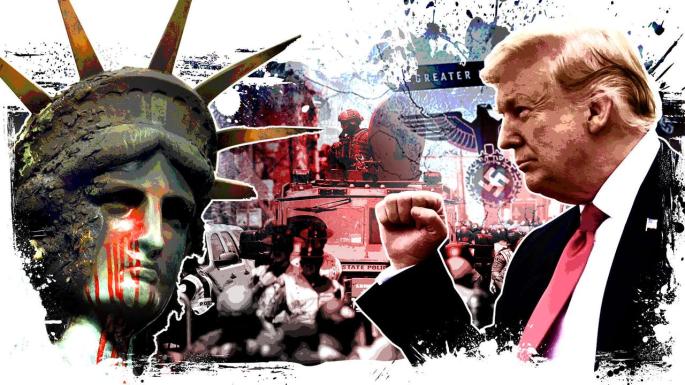
As a result, the Western world has become disenfranchised by the formerly indestructible symbol of liberty and equality. As the ideas, values and thoughts of her own citizens become increasingly volatile with the left skewing further to the socialist embers of her former enemy in the Soviet Union, and the conservative right falls further to the depths of militaristic fascism and overt patriotism that consumed Nazi Germany in World War 2.

Loss of Freedom and Liberty

Throughout the tenure of modern history, the common political values of mutual respect and civil debate stood steadfast despite theological, ideological and economical disparity. However, the commercialisation of the political dimension in the 21st century through the capitalisation of the broadcasting industry has led to a vacuum of unbiased, neutral freedom of thought. The absence of a valid and respectable centrist entity is a major contributor to this gradual degradation of the social connections between the left and right.

The view of both elements of this divide is that the very fact that the existence of a disparity in ideology is a testament to the success of the American system of liberty and freedom. This view is remarkably ignorant of the destruction of the centrist belief in the existence of a ‘balancing mediator’ that can conciliate the differences between the cultural entities of the West. The vacuum of rationality, objectivity and logos (logical thinking over emotion) is the defining symptom of an ideology in the process of eternal separation and division.

As the rational elements of the West continue to fade away into the history books. The very freedom of speech, assembly and thought will disintegrate into the emotional frontiers of both sides of the proverbial fence. The fabric that held everything together, and wrote the Declaration of Independence will be forgotten, and the emergence of the Eastern values of emotional conformity, elitism and suppression of incompatible thought will prevail in the homeland of the free. Inevitably, spread to the body of the West in Europe, Australia and South America.

The East is the New West

Like any ideological war, the fronts of battle are not fought in the physical realm and are not tied to a specific moment in time. The slow dissolution of the fundamental Western values is a timeless process that was sewn with the introduction of classism, elitist control of media and technological suppression of religious and heterodox scientific polity in a supposed secular world.

The world is slowly changing. Many may not see it.

The West is becoming everything it sought to destroy. Like any self-fulfilling prophecy, the result is exactly the outcome that was unacceptable in the first place.

By Daniel Dell’Armi

Ideological Warfare: The Divided States of America

The United States of America was the frontier of liberty within the world as we know it. The first modern nation to establish a constitution, independent of monarchial or autocratic chains, that represented the sovereignty of the people. Its people galvanised by the common values of civil liberty, prosperity and welfare. Why has this shared belief dispersed into a physical and political warzone of ideologies?

To understand the current climate within the USA, it is imperative to empathise with the different ideologies that collide in the nation. In the most simplistic framework, the political landscape is divided into a progressive, and opposing, conservative wing. These ‘wings’ are a dichotomy, or the so-called unbreakable duo. Ying and Yang. One cannot exist without the other, and both will continue to exists whilst the other survives.

The progressives strive for changes and improvements to the institutions within the nation, no matter the cost. Whilst the conservatives commit to stability and continued legitimacy of the executive, legislative and judicial branches that bind the American society together, at the expense of progression.

The progressive wing embodies a bucket of different beliefs that ultimately promote the increased welfare of all people unilaterally. Usually through social welfare programs such as Medicaid, ObamaCare and NGOs such as Planned Parenthood, as well as limiting the power of wealthy individuals and corporations. Whereas, the conservative wing represents the various values that strengthen representative institutions (government, religions, community groups) that are regulated by the people. This is achieved through the financial support of law enforcement and diminishing the tax burden for citizens and small-medium businesses.

Contrary to popular belief, these wings have changed political allegiance drastically over-time. The progressive wing was represented by the Republicans (and Whigs before them), their first presidential leader being Abraham Lincoln. His anti-slavery approach and determination to build public infrastructure epitomized his progressive mantra. Whilst the conservative wing was dominated by the pro-slavery Southern Democrats.

The first physical battle of the progressive and conservative wings manifested in the Civil War. The progressive Republicans determined to free the enslaved African American population in the South. Willing to literally die for change and destroy the institutions that permitted the archaic practice to thrive. As the Confederacy and the conservative Southern Democrats battled to maintain the autonomy of their own institutions. The cost? 618,000 human beings.

In the aftermath of the Civil War, the make-up of the dominant political parties transformed into the parties we know today. Of course, the conservatives retain power in the Republican party, whilst the progressives exercise their influence through the Democratic platform. However, the most important lesson is that progression and conservatism do not have the same face, they change and adapt like chameleons to the political environment around them.

As the political landscape became popularised with the election of Ronald Regan. The Democatic and Republican parties began the second weaponisation of progression and conservatism. Political elections became corrupted by frivolity on both sides, driven by toxic campaigns designed to undermine the the core identity of the opposing power. Lobbyists bet on a winner through donations, like a sport. Political activists became guerilla warfare experts, striking their opponents with timely public protests to derail campaigns. As the notion of political chivalry died with a decaying nation.

This can all be seen in the light of day in the previous election, as Donald Trump championed the unspoken conservatives and Hillary Clinton rode on the passionate voices of a new, progressive generation. A divisive campaign on both sides militarised the conservative and progressive wings into combative forces determined to dismantle the other without the thought of consequence. Powerful media monguls glorified the battle into a noble and just war on their respective opposition. CNN, MSNBC and other mainstream outlets on one side; and Fox News with the assistance of right-wing social media news platforms bringing in the competition.

The death of George Floyd, was a catalyst that has renewed the war onto a new front. Protests in the name of progression have spread across many states in the USA, with the nucleus in Minnesota, Los Angeles and New York. Law enforcement has become the embodiment of the conservative wing, protecting the integrity of the institutions that provide liberty to the population. As the progressive protesters stand in unity, exercising their own liberty to battle against the oppression of not only the African American community, but also those lost within the system without a voice. This is no longer about the unjust and horrible death of an African-American man in police custody. It is war of two ideologies, an unofficial Civil War.

This is the Divided States of America. A country founded on liberty. Liberty’s children, progression and conservatism are fighting the eternal sibling rivalry.Who will win? Not the people. As evident in history, the only winners of any war are those that fund both sides. The TV broadcasters, corporations, corrupt NGOs and foreign powers.

As the forces of progression and conservatism timelessly collide, the real villains escape into the darkness without accountability. Can the American people spot them in time?

Daniel Dell’Armi

Post-Covid 19: What is our Economic Plan?

What did the Prime Minister say?

As the economic shockwaves from the Covid-19 pandemic continues to permeate throughout the globe, Australia looks ahead to the future. A determined Scott Morrison delivered a patriotic speech at the National Press Club on Tuesday, 26 May. The message was clear: Australia is on the mend, but we must pull through together. 

The Prime Minister used a collaboration of populist and patriotic expression to quell fears of uncertainty for the future. The speech riddled with nationalistic undertones praised Australians for their grit, courage and resilience through a turbulent year. Whilst many will view this rhetoric as necessary in order to bring the nation together to combat the biggest economic challenge since the Great Depression. A small minority can view this as ‘papering over the cracks’ and a whimsical plea to maintain harmony until a concrete plan for economic action is implemented.

What are the goals?

Nonetheless, the Prime Minister did outline his ambitious objectives for the short-medium term. Drawing upon the unanimous support from key influential figures in federal politics including the Treasurer, Deputy PM and leader of the Senate. The PM revealed that his government’s focus would be on industrial relations; as the key to rebuilding the fragile economy. He will chair five working groups for discussions to produce a ‘JobMaker’ package. On the list of discussions include award simplification, fundamental enterprise agreement-making, Fair Work Commission reviews on casual and fixed term employees, compliance and research into ‘greenfield’ agreements for new enterprises.

Why the focus onAustralian jobs and industrial reform? Is it to increase employment and helps the millions (circa 2 million) of Australians out of a job to curb the surging unemployment rate? Is ScoMo genuinely trying to give “a go for those who have a go”? Whilst all these reasons will be publicly promoted as the main reasons for the creation of JobKeeper and JobSeeker. The opposition will argue the government is glorifying its achievements. However, as is often the case in national politics, there is a simple economic reason for the salience of labour market reform and business cash splashes from the government.

Stabilisation or liberalisation?

To understand the agenda of the government, it is important to analyse the economic and political tools at the executive’s disposal during these uncertain times. As clearly demonstrated by his national speeches, the PM has utilised patriotic sentiment and nationalist wordage (this is most evident in his over-used platitude` “how good are Australians?”) to stabilise the population. Majority of political pundits will agree that this has worked effectively, despite the ‘mass buying’ hysteria during the initial phases of the pandemic. Certainly, compared to highly liberalised nations like the U.S, Australia has been quite passive with little organised movements against lockdowns and quarantine. We can mark this as a win for the government.  

Since the Australian public is stable and social institutions are still operating relatively well despite abnormal societal conditions. The Federal Government can begin to dig deeper into its bag of tricks to commence the long and argues economic turnaround.

The Economic Options: The Centre-Right Playbook

The government has two macroeconomic policy tools, fiscal and monetary, that are commonly used in the event of a systemic shock, just like Covid-19. These tools are ‘stabilisers’ that are aimed to prevent the economy of ‘overheating’ in booms or underperforming in periods of decline. The right-wing Liberal party is founded on the ideals of ‘small government’ and market-based solutions. Henceforth, the government has utilised ‘fiscal consolidation’, in other words, minimalised discretionary spending in order to produce a budget surplus. As seen in the pandemic, welfare-state policies such as JobSeeker and JobKeeper are often seen as a last resort and primarily used to keep businesses afloat. This can be seen by the design of JobKeeper, which is primarily provided to businesses that have experienced a significant drop in revenues.

Due to the costs of such large fiscal policies, the right-wing politics of the current cabinet is unlikely to pursue similar programs such as a JobSeeker for the foreseeable future. (In fact, it is expected to expire without renewal in September). The reluctance to utilise the excess $60 billion from the accounting error in late May is only further proof of the right-wing ‘debt hawk’ stance. Therefore, we can expect large social programs such as JobSeeker to remain an exception to the rule.

Why not interest rates?

Since fiscal policy is an unlikely source of economic stabilisation, one may turn to interest rates (or monetary policy for those who like economic jargon). Interest rates are a great macroeconomic tool that aims to control inflation, credit supply and stabilise unemployment. The basic theory is that it is a transmission mechanism, managed by the RBA as an independent actor from the federal government. The RBA will use the purchase/sale of government securities to shift the cash rate. However, the cash rate has reached historical lows at 0.75% prior to the pandemic. In response to the crisis, it was lowered to 0.25% in a counter-cyclical effort to promote consumer expenditure, reliable credit and business/investor confidence.

This may be effective in the short-term, but what will the RBA do in the medium term? The rates cannot go any lower as we have hit the proverbial ‘zero low bound’. Whilst the ECB (European Central Bank) has experimented with negative interest rates, the norm certainty suggests this is an outlier. Hence, the RBA will employ extreme caution and avoid lowering rates any further, which has been indicated by Phillip Lowe. The same can be predicted for financial institutions, whom rely on a healthy interest rates spread for profit. Therefore, the mystical powers of interest rates are far less appealing in the eyes of a cautious government. 

Why Industrial Reform?

As a result, the PM has limited options in the federal economic arsenal. Where does the government turn to vitalise the expected and needed economic revival? The answer is simple and easy to promote to the public. Microeconomic reform. Or more simply… cut industry tape and create jobs.

Microeconomic reform transcends a range of domains in the economy. It is mostly associated with the reduction of ‘red tape’ in the production process through the division of labour. Workers (labour) specialise in their most efficient activity, theoretically each worker becomes more productive and thus engenders greater output. This is reflected by a higher wage as the worker becomes more valuable. The Prime Minister plans to implement this basic economic ideology on multiple fronts, condensed into the proclaimed ‘JobMaker’ package.

What can we expect?

The expectation is the government will invest in vocational training that provide skills that are required for specific jobs in the ‘new’ digital economy. TAFE courses will become cheaper and more abundant, as Australians will be encouraged to become more productive. Flexible workplace options will become the norm such as ‘working from home’ and ‘flexi hours’ that effectively reduce the burdens of travel and brick & mortar that erode productivity. Universities will also benefit from an influx of domestic students to offset the loss of international students.

On the state government level, firm-specific leakages such as the payroll tax will most likely be abolished as a means to alleviate the financial distress of the small-medium enterprises. The expectation that rational owners and entrepreneurs redistribute these savings to improve the efficiency of their businesses.

The Final Verdict

The opposition will argue that the microeconomic policy approach very approach is not conservative for a ‘small government’ that the Liberal party embody. However, the Liberal party understand that microeconomic policy is underpinned by the Keynesian belief that such reform will increase the long-term supply capacity of the economy. As such, the intertemporal benefits outweigh the numerical investment. Therefore, those with a keen political eye may view the approach as a ‘pseduo-fiscal’ policy designed to improve confidence of the working class to spur consumerism. Either way, the incumbent government has an uphill political battle on its hands. These policies are a long-term play in a word of myopic ideologies. So this begs the question… will Scott Morrison survive the upcoming ideological war without a strong economy to stand upon? 

Daniel Dell’Armi

Death of Democracy

Democracy is the defining achievement of humanity. The representation of the intellectual evolution of a complex species. The erosion of the simplistic notions of natural selection survival, and transition into a self-aware community of living organisms.

Ancient Period

Originally, created by the Athenians circa 5000 BCE, this form of government is a rare occurrence throughout human history. The dominance of authoritarianism, aristocratic societies, autocracy and theology (fundamentalism) is a common theme throughout modern and ancient human history.

The Ancient Egyptians, the primordial civilization, redefined the meaning of innovation. The Great Pyramids, agricultural reformation on the Nile and promotion of trade. This kingdom exercised structuralism exclusively through theism. The Pharaoh, the living representation of the gods, enforced the laws of the metaphysical forces through a centralized government.

The Ancient Roman Empire tweaked this blueprint with a few minor changes. The polytheistic premonitions and subservient population remained. Whilst political power channeled through the Emperor, acted as the executive branch in an autocratic world. This provided the catalyst for the rise of slave-based economies, free trade and feudalistic societal organization that would dominate Europe for centuries to come.

In an economic sense, the eternal love for the centralized distribution of power in a government system is a tantalizing prospect. This encompasses the narrative that a single entity can control the outcome of several situations. Thus, in the event of an undesirable situation., the ‘visible hand’ can reallocate resources in order to maximise output for society.

As the fruits of authoritarianism became clear throughout the ages. Its success and prominence grew with each generation. Exaggerated by lack of education, largely agrarian communities, familial inheritance and militarization of national borders. A vicious cycle developed that could not be broken by subservient populations. Many would see authoritarianism as prosperous for humanity, a necessary sacrifice for the survival of ‘enlightened’ civilisations.

The Ancient Greek society, the birthplace of modern philosophy, literature and arts. As the supreme outlier in the Athenian times, developed a revolutionary concept. A representative democracy. A concept so civilized in a time dominated by realist policies of strength and might over national enemies. However, deeply flawed by the restricted representation of women, disabled and marginalized in society.

As a fleeting light in the tunnel of time in the ancient period of human civilization. The Ancient Greek society dissolved into the authoritarian whirlpool of war. The Macedonians, Persians, Romans and numerous other sovereign states eroded the fabric of the democratic society. As mighty rulers assumed control of the autonomous Greek governments and transformed them into a puppet of more powerful empires.

Modern Period

Despite the appraisal for the Enlightenment and Renaissance era in the late Middle Ages. The real source of change for the governance of humanity was the Industrial Revolution.

The manufacturing phenomenon of the 17th Century is the primary catalyst for the drastic transformation of human civilisaitons. Compounded with the innovations of the electricity, telephone and superior modes of transport (trains). The Industrial Revolution became more than a dynamic, post-Ancient era for human intelligence in manufacturing.

A redefinition of the structure of the global economy. The agrarian dominance in the Ancient times were soon to be forgotten. The value of the working class would increase astronomically as their skillset became invaluable to the manufacturing process. The feudalistic system of farming in the Western European nations would slowly dismantle as the lower classes became more educated and skilled in society.

The arrival of the ‘middle class’ indicated a shift in the power distribution within society. Most notably the power of the elite became diminished as the need for innovative, intelligent and productive workforce to meet the demand of industrialization became apparent. The sovereignty of the populace became imperative to the progression of society. No longer did the elite possess the supreme sovereignty to decide the future of civilisation, rather the individual possesses one’s own sovereignty.

Contemporary Era

Hence, the post-modern era of the digital world that is intertwined in a globalized economy. The rights of the everyday human are enshrined in the legal documentation of national constitutions and sometimes in ratified ‘Bill of Rights’. Not to mention, the implementation of statutory law that prevents discrimination, stereotyping, slavery of any kind, defamation and involuntary marginalization of peoples.

These rights and freedoms represent the victories over a timeless battle between the impoverished ‘middle’ and ‘lower’ class and the elite. The implementation of modern democracy is a testament to the progression that humans as a network of intelligent beings have made. The very ability to decide one’s own future is a gift and privilege. Modern representative democracy with limited restrictions on access for citizens is the very foundation of this moral philosophy.

The executive, judicial and legislative branches act as ‘checks and balances’ for modern democracy. The various parliaments across sovereign lands are bound by the duty to debate the acceptance of ‘bills’ into legislation in often multi-party systems. The complimentary legal institutions uphold these laws in the form of hearings, trials and appeals that are bound by a jury or appropriate representative. Whilst the executive branch binds the population together as the pinnacle of leadership and responsibility for those less fortunate in society.

The federal, state and regional governments are autonomous and decentralized to disperse the influence of the elected and unelected officials in the public domain. Therein, not one parliament can dislodge the proceedings of another without due course.

However, despite the innumerable amount of freedom individuals as private entities retain in contemporary society. There is an alarming rise in authorial institutions that blatantly disregard and undermine the values of democracy.

The increased influence of the executive branch in Australia is a particular concern for those with keen political eyes. The development of a ‘National Cabinet’ in the wake of the Covid-19 crisis is a very bright red flag. The cabinet has the full ability to implement social distancing restrictions using the ‘Public Health Orders’ supported by the ‘Public Health Act 2010’.  The procedures associated with the legislative branch are effectively rendered useless. Under the guise of the priority of public health.

This begs the question of: when do we classify a situation as a ‘public health’ crisis? This is normally deemed by the executive branch itself, on the orders of experts in the field. This represents a conflict of interest since a crisis only provides the executives more power. The lack of independent oversight by a committee that represents the population is a severe flaw.

A possible solution is the implementation of a ‘postal vote’ system for situations that may invoke a ‘national emergency’ or ‘public’ crisis. This would transfer the power from the executive branch to the population through the legislative branch. Clearly, the value of expert opinion would need to be accounted, however the final decision should be laid at the feet of the population, rather than unelected officials.

To make this point even more potent, we can attribute some of the core values of the Covid-19 crisis to ongoing issues within society. For instance, the public health domain can be contrasted to the digital domain of the World Wide Web (WWW). This is a public domain that has its own set of rules and is loosely government by the legislative branch.

The development of the internet has led to the invention of social media platforms. These platforms are designed to provide a medium to express individuality in a real-time context instantaneously. Despite the promotion of these entities as merely platforms, they have incorporated ‘community guidelines’ that act inauspiciously as laws for the digital society. These guidelines, like the organization of modern society, are enforceable by a judicial committee and created internally by senior stakeholders. Since these stakeholders do not represent the public, rather its profit-maximizing stakeholders. This set-up is more akin to an oligarchic society.

Since social media plays such a pivotal role in the cohesion of human civilisation. The fact that these platforms invoke the authorial notions of the ancient and pre-modern times is a concern.

The Future

 Humanity has struggled with an imbalanced distribution of power since the dawn of time. This balance has become more even since the Industrial Revolution. However, there seems to be a shift again towards elitism.

The rise of conglomerates such as Google, Facebook, Microsoft, Apple, Nike and Disney (and many others) is macrocosm for a greater issue within the ‘new’ era of society. These companies are not bound by the democratic laws that maintain the freedom of individuals in a dynamic world. Not to mention, the increasing centralization and militirisation of the executive branches of government.

Whilst broadcasting channels will continue act in their own self-interest and fail to provide an effective platform to voice these concerns. It is inevitable that the elite will become integrated into the bowels of the IT and public institutions that dominate the decisions made in the globalized world today.

The true question remains: are we too late to stop it?

Daniel Dell’Armi

The Moral Authority of Social Media

Global communication has evolved dramatically in the new millennium. The omnipotence of social media as a platform is not only responsible, but accountable, for the distribution of information in a technocratic society.

Social media is a quasi-virtual dimension that exists independently from the physical world of communication. Communication throughout the modernised world has been mainly dominated by hardware. Letters, postcards, radio, television, fax. These channels of communication are easily regulated and monitored by figures of authority. As potentially valuable content is missed by the public; but inflammatory rhetoric is by the same measure unlikely to see the light of day.

However, the rise of social media has completely transformed this idea of regulated communication. Anyone at any time can publish their thoughts, with the only limit being their imagination. The innate desire to impose one’s ideals, beliefs and values on others is finally actionable by the population without strict regulation of authority. This is power that no one in human history has exercised before. It is this insatiable lust to be recognised and appreciated by the masses that has led to the monopolisation of social communication.

The ability to instantaneously inform, promote and educate is unprecedented power. Unfortunately, there are only a few providers in this oligopoly. Facebook, Instagram, Twitter and SnapChat epitomise the dominance of social media in the daily lives of ordinary citizens. They represent the collective power of users and act as accelerants for equally good and bad ideas.

These profitable organisations employ their own self-regulated ‘code of conducts’ and ‘community guidelines’. These rules are the ‘laws’ of speech in the dimension of social media. Unlike the federal and state judicial systems that govern the realms of free speech in the physical realm. The makers of social media laws are an unseen group of corporate individuals. Their goal, as for any commercial organization, is to protect their profitable interests and advertiser-friendly platforms.

Many will argue that the mere existence of such laws on social media restrict the basic right of freedom to speak one’s mind without consequence. Whereas, others will argue that these laws are the cornerstone of a safe and inclusive community, which represents the statutory laws implemented by western society. In either case, the moral authority of verbiage posted on social media is determined by institutions created to make a profit in a capitalistic economy.

This leads to a far large systematic question: are we best governed by the laws of national governments or profitable institutions? The fracture between these two moral authorities can be seen all around the world today. Celebrities and citizens alike have lost their livelihoods and careers due to immature, racist, misogynistic and discriminatory remarks on social media. On the other hand, the judicial system operated by national governments condemn those to the same fate that exercise discrimination in the workplace, public and privately.

What is the difference between these two authors of moral authority? Governments in westernised culture employ ‘balance and checks’ in the form of a jury or impartial judge to determine the innocence of any one person in a civil case. As well as implementing a long and formal process that takes weeks to months to complete. Contrastingly, social media corporations use software algorithms to catch any misguided behavior online. In some cases, they will immediately warn or ban the user without an internal review by its team.

It is this very conflict between the authority of government and the privatised world that will continue to dominate morality for years to come. Facebook and its companions will remove the voices of those they deem guilty of hate speech and detestable behavior. Whilst the democratic judicial system will punish those guilty in the perceived just eyes of the written and common law.

As a human race, we need to ask ourselves an existential question that will define our existence for centuries to come. Are we better under the eyes of the common law or the code of a computer?

Daniel Dell’Armi